
Choosing the Right Area Rugs: Size and Style That Fit Your Space
Estimated reading time: 7 minutes
Key Takeaways
- Area rugs are fundamental in adding warmth and defining spaces.
- The size of the rug significantly impacts the feel and flow of the room.
- **Small oriental rugs** work best in intimate settings or as accents, while **large oriental rugs** help anchor larger furniture groupings.
- Proper measurements and placement rules enhance aesthetic and functional appeal.
- Consider design harmony when layering multiple rugs for a cohesive look.
Table of contents
Introduction: Area Rugs and Why Size Matters
Area rugs are more than just floor coverings—they are foundational design tools that add warmth, color, texture, and definition to a room. They help anchor furniture, create visual zones in open-plan spaces, and influence how large or intimate a room feels. Choosing the right rug size is critical because:
- A rug that is too small makes a room feel disjointed and cluttered.
- A rug that is properly sized connects furniture into a cohesive grouping and balances the proportions of the space.
In this guide, you’ll see how different area rugs work in practice, with a focus on comparing small oriental and large oriental rugs—their style, function, and best use cases.
Overview of Area Rugs
What Are Area Rugs?
Area rugs are movable rugs that cover a portion of the floor rather than wall-to-wall carpeting. They can be placed over hard flooring (wood, tile, laminate) or over existing carpet to add definition and style. For additional guidance on selecting the perfect rug, check out this resource.
How they differ from other rugs:
- Wall-to-wall carpet: Fixed, covers the entire floor; area rugs are removable and typically smaller than the room.
- Runners: Long, narrow rugs primarily used in hallways, entryways, or alongside beds and kitchen counters.
- Doormats: Functional, placed at entries; smaller and focused on dirt control rather than decor.
By using area rugs in different rooms, homeowners can easily change color schemes, patterns, and zones without major renovation, highlighting their versatility and broad range of sizes and styles.
Role of Area Rugs in Interior Design
Area rugs play several key roles:
- Anchor furniture groupings: In living rooms, they visually tie together the sofa, chairs, and coffee table.
- Define zones: In open-concept spaces, they can separate a seating area from a dining area or workspace.
- Add comfort and warmth: Softer underfoot than hard flooring, improving acoustics and comfort.
- Introduce color and pattern: Oriental and patterned rugs can become a focal point or complement existing furnishings.
In design terms, rugs area (the rug’s footprint within a room) is a primary tool for shaping how a space is perceived—larger rugs often make a room feel more cohesive and expansive, while smaller rugs can highlight specific features or furniture pieces.
Comparing Rug Sizes and Styles: Small vs. Large Oriental Rugs
Style, Pattern, and Proportion Differences
Small oriental rugs (often in sizes like 3’×5′, 4’×6′, 5’×7′):
- Visual impact: Act as accents or focal points, drawing attention to a specific spot (entry, fireplace, bedside).
- Pattern perception: The intricate detailing is concentrated, making the design appear more intense and jewel-like.
- Proportion: Best when they clearly sit within a defined zone—under a coffee table, in front of a console, or in smaller seating nooks.
Large oriental rugs (commonly 8’×10′, 9’×12′, 10’×14′):
- Visual impact: Create a dominant field of color and pattern that unifies the room.
- Pattern perception: The design reads more as an overall field; motifs feel more integrated, less “busy.”
- Proportion: Designed to hold entire furniture groups, aligning with standard layout rules (all or front legs of furniture on the rug).
In terms of style, both small and large oriental rugs can carry traditional medallion, all-over, or geometric patterns, but the scale of those patterns will feel different depending on rug size: a central medallion may be a bold centerpiece on a large rug, while on a small rug it can become the primary visual focus for a small vignette.
When Each Size Is Most Appropriate
Best scenarios for small oriental rugs:
- Entryways and foyers: A 3’×5′ or 4’×6′ rug can add color and form a welcoming focal point without covering the entire floor.
- Bedside or reading nook: Smaller rugs placed beside the bed or under a single chair create cozy micro-zones.
- Kitchen or hallway runners: Narrow small rugs or runners work well where you need function and style but limited coverage.
- Layering over larger rugs: A small oriental can be layered over a neutral large rug for added character.
Best scenarios for large oriental rugs:
- Living rooms: Typical sizes like 8’×10′ and 9’×12′ allow sofas and chairs to partially or fully sit on the rug, anchoring the seating area.
- Dining rooms: Large rugs that extend 24–36 inches beyond the table on all sides ensure chairs remain on the rug even when pulled out.
- Bedrooms: A 8’×10′ or 9’×12′ rug under a queen or king bed provides a generous soft surface around the bed.
- Hallways and entries: Runners should ideally contrast in design or function, providing both aesthetic and practical use.
Here, rugs—using multiple rugs in one home—can differentiate each functional zone: small oriental rugs for accent and circulation areas, large oriental rugs for primary seating or dining zones.
How Rug Size Changes Room Feel
Size directly affects the perceived mood and scale of a room:
- Large rugs:
Make rooms feel more unified and visually larger by reducing visual breaks in the flooring. Convey a sense of permanence and formality, especially with classic oriental patterns. - Small rugs:
Emphasize specific furniture or architectural features. Create more intimate, layered, or eclectic effects, especially when used in multiples in the same room.
For further guidance on how rug size can transform a space, visit this website.
Design guidelines often suggest “bigger is better” for main seating areas, as undersized rugs can make furniture feel disconnected and the room visually fragmented.
Matching Rugs to Your Space
Measuring and Determining the Right Rug Size
Before choosing area rugs for any room:
- Define the zone you want to anchor: seating group, dining area, bedside, or passage.
- Measure the length and width of that zone, including furniture footprints.
- Apply standard clearance rules:
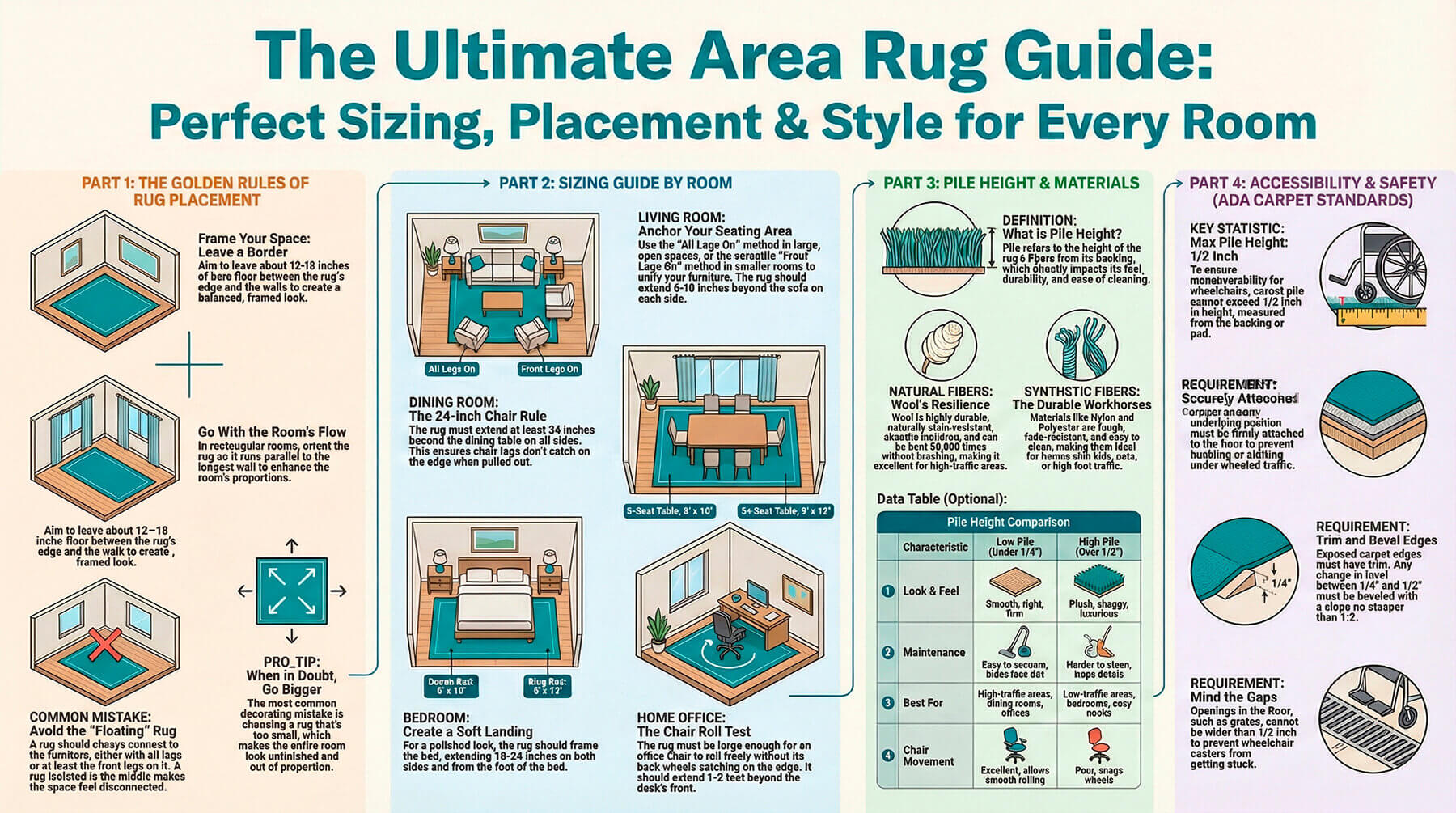
– Leave about 18–24 inches of exposed floor around a rug in most rooms to maintain balanced proportions.
– For living rooms, allow 6–18 inches of space from rug edges to walls, depending on room size. - Use painter’s tape to outline the proposed rug size on the floor and visually test different dimensions.
For additional room-by-room sizing tips, check out this article.
These steps help you align the rugs area (actual footprint of the rug) with both the room dimensions and the furniture arrangement.
Practical Design Considerations: Rugs Area and Placement
Rugs area—where the rug sits within the room—affects:
- Traffic flow: Ensure pathways around furniture remain clear (often 18–36 inches for walkways).
- Furniture stability: Aim to get at least the front legs of major seating pieces on the rug to prevent a “floating” look.
- Visual balance: Center the rug relative to the furniture group more than the room’s walls when the furniture is the main visual focus.
Key room-specific guidelines:
- Living room:
Common practice: all front legs of seating on the rug; larger rugs can accommodate all legs. Rug often extends beyond the sofa by 6–8 inches on each side. - Dining room:
Measure the table; add 24–36 inches on each side so chairs stay on the rug when pulled out. - Bedroom:
Rugs should extend 18–24 inches beyond the sides and foot of the bed for comfortable stepping zones. - Hallway/entry:
Runners should leave 4–6 inches of visible floor on each side.
Blending Multiple Rugs and Styles (Rugs and Rugs)
In many homes, using rugs and rugs together—different sizes and styles in adjacent spaces—creates a layered, coordinated look:
- Within one large room:
Use a large oriental rug for the main seating area and a small oriental rug or runner for a reading nook or entry portion of the same room. - Across connected spaces:
Choose related colors or patterns so rugs feel harmonious but not identical—e.g., similar palette, different motifs.
Design tips when combining multiple rugs:
- Keep at least some shared elements (color family, texture, or pattern style) to avoid visual chaos.
- Use rugs to reinforce functional zones (dining vs. lounge vs. workspace) in open-plan layouts.
- Avoid placing two highly detailed oriental rugs immediately adjacent if their patterns clash—consider pairing one ornate rug with a more subdued companion.
Explore creative layering ideas at this link.
Integrating Rugs into Common Room Layouts
Living rooms:
- Typical rug sizes: 6’×9′, 8’×10′, 9’×12′ depending on room size.
- For smaller living rooms, a 5’×7′ or 4’×6′ rug may sit under a coffee table or pair of chairs.
- Orient rugs with the room shape and seating layout; larger rugs tend to make the space feel more inviting.
Dining areas:
- Rug should be large enough to hold table and chairs even when chairs are pulled out—generally 24–36 inches beyond table edges.
- Consider round rugs for round tables and rectangular rugs for rectangular tables to enhance cohesion.
Bedrooms:
- Place a large rug under the bed, extending beyond sides and foot, or use two runners along each side if the bed is near a wall.
- Match size to bed: 5’×8′ for Twin, 6’×9′ for Full, 8’×10′ for Queen, 9’×12′ for King.
Hallways and entries:
- Use runners with 4–6 inches of exposed floor on each side.
- Small oriental rugs can highlight a front-door area or vestibule while larger runners guide traffic through a corridor.
Comparing Style, Function, and Fit: Small vs. Large Oriental Rugs
Side-by-Side Comparison
| Aspect | Small Oriental Rugs | Large Oriental Rugs |
|---|---|---|
| Primary role | Accent, focal point, or micro-zone | Anchor main furniture groups and define major zones |
| Typical sizes | 3’×5′, 4’×6′, 5’×7′ | 6’×9′, 8’×10′, 9’×12′, 10’×14′ |
| Pattern perception | Intense, jewel-like, highly focused | Broad field, integrated pattern, less visually “busy” |
| Functional focus | Entry, bedside, small seating, layering | Living, dining, full bedroom layouts |
| Impact on room feel | Intimate, eclectic, layered | Cohesive, spacious, formal or semi-formal |
Balancing Aesthetics and Function
Small oriental rugs are ideal when:
- You want a decorative statement in a compact area (entry, fireplace zone).
- Function demands smaller coverage (tight hallway, kitchen).
- You plan to layer rugs over a neutral base, using pattern sparingly.
Large oriental rugs are ideal when:
- You need to anchor furniture and create a unified seating or dining area.
- You want the rug to serve as a primary design element—color palette and pattern that set the tone for the entire room.
- Comfort and coverage around seating and beds are priorities.
In both cases, aligning the rug size with standard measurement guidelines (clearance from walls, furniture leg placement, and rugs area relative to room dimensions) ensures the rug is not just beautiful but also functionally successful.
Conclusion and Recommendations
When choosing between different area rugs sizes and styles, focus on three core factors: room dimensions, furniture layout, and desired function of the rug.
Key takeaways:
- Use larger oriental rugs to anchor major furniture groupings and make rooms feel more cohesive and spacious.
- Use small oriental rugs for accents, entries, bedside areas, hallways, and layered looks where targeted pattern or color is desired.
- Respect standard sizing rules—exposed floor borders (about 18–24 inches), extension beyond dining tables (24–36 inches), and bed-side coverage (18–24 inches)—to maintain pleasing proportions.
- Think in terms of rugs area and how your chosen rug footprint interacts with traffic paths, furniture, and adjacent zones.
As you plan your own area rugs area rugs strategy, consider your unique space requirements: room size, existing furnishings, lifestyle (pets, kids), and maintenance preferences. For more tailored decisions—such as selecting specific standard sizes or fine-tuning placement—consult room-by-room rug size guides or work with an interior designer who can assess measurements and layouts in detail.
Happy rug hunting and decorating!
FAQ
What are the benefits of using area rugs?
Area rugs add warmth, define spaces, enhance comfort, and can act as a decorative focal point in a room.
How often should I clean my area rug?
It is recommended to clean your area rug every 6 to 12 months, but high-traffic areas may require more frequent cleaning.
Can I layer rugs?
Yes, layering rugs can add texture, depth, and visual interest to a space, as long as they are harmonious in color and style.
What size rug should I use for my living room?
The ideal size for a living room rug is one that accommodates the front legs of your furniture or fits underneath the entire seating area, typically ranging from 6’×9′ to 9’×12′ depending on the layout.