
The Art and Craft of Hand Knotted Rugs
Estimated reading time: 6 minutes
Key Takeaways
- Hand knotted rugs are unique, each telling its own story through craftsmanship.
- The detailed process of creation includes design, material selection, knotting, and finishing.
- Persian knots such as Senneh and Ghiordes are essential to the unique character of these rugs.
- Understanding the history of rug making enriches appreciation for these beautiful artifacts.
- Evaluating quality involves understanding material, technique, and artistry.
Table of contents
- Introduction: Enduring Appeal of Hand Knotted Rugs
- Historical Background: A Timeline of Rug Making
- Deep Dive: “Hand Knotted Rugs How to Make” – Step-by-Step
- Materials, Tools, and Techniques
- Persian Rugs Techniques
- Craftsmanship Processes and Best Practices
- Conclusion: Bringing History and Technique Together
Introduction: Enduring Appeal of Hand Knotted Rugs
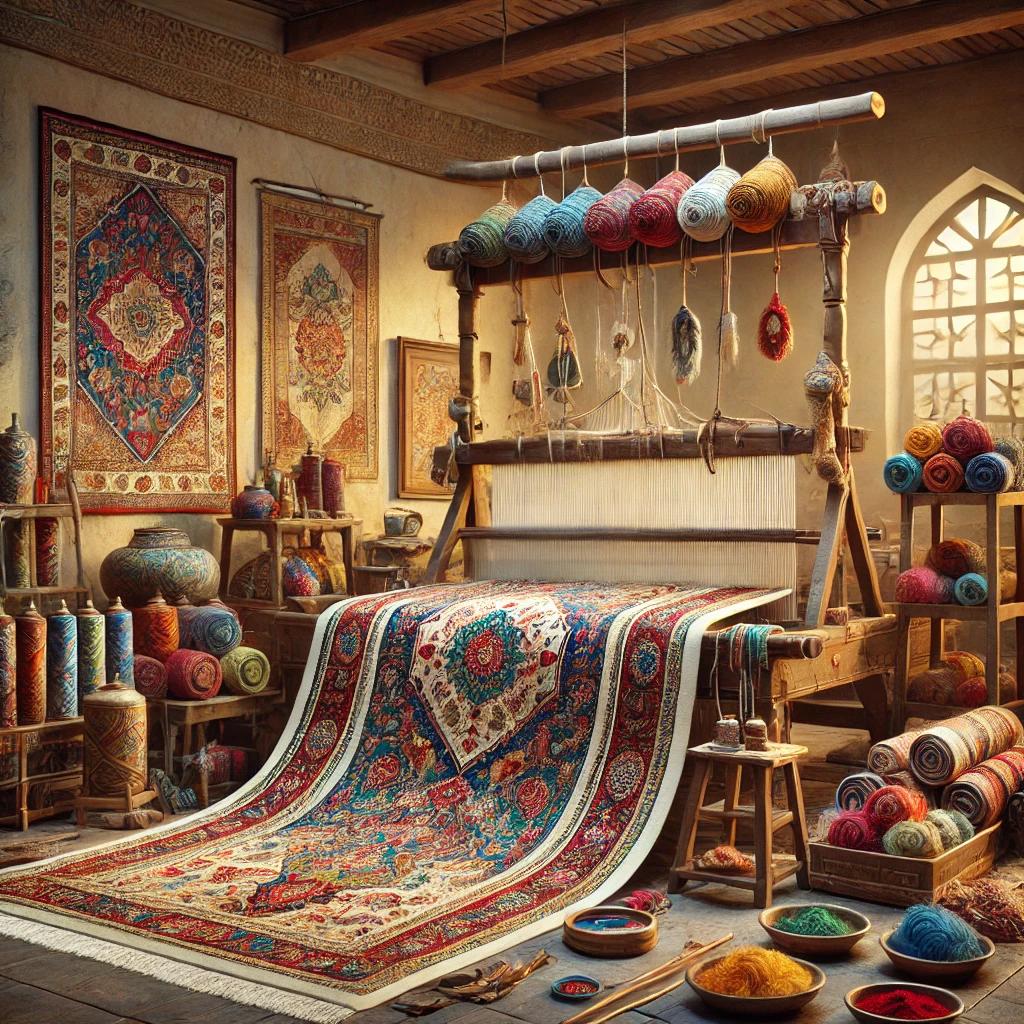
Hand knotted rugs are unique handcrafted textiles meticulously created one knot at a time on a loom. This labor-intensive method produces not only stunning visual designs but also offers remarkable durability. Each rug embodies its own story, infused with organic characteristics that machine-made alternatives lack. As a result, hand knotted rugs appeal to buyers looking for both beauty and resilience.
The central theme of this blog is “hand knotted rugs how to make,” which refers to the comprehensive process involved in their creation—from meticulous design planning and material preparation to the intricate knotting, washing, and quality inspection. Understanding this detailed workflow is crucial for appreciating the history of rug making and the skill involved in modern craftsmanship.
These rugs cannot be replicated. Each knot tied by hand ensures that even rugs featuring the same designs display subtle variations, making each piece one-of-a-kind. For a deeper comparison of techniques, read how hand-knotted vs. hand-tufted rugs differ in craftsmanship and uniqueness.
Historical Background: A Timeline of Rug Making
Early Origins: The Pazyryk Carpet
The journey of rug making is rich and fascinating, with roots stretching back thousands of years. The Pazyryk carpet, discovered in a Siberian burial mound, dates to the 5th–4th century BCE and is recognized as the oldest surviving hand knotted rug. This remarkable piece showcases sophisticated design techniques, indicating that advanced rug weaving traditions existed more than 2,500 years ago. It can be classified as a Persian carpet, reinforcing the idea that Iran’s cultural sphere held a significant position in the early history of rug production. Learn more about it here.
Cultural Development Across Cultures
Throughout the ages, countless cultures have employed different knotted techniques. The first hand knotted rugs were a natural evolution from earlier flat textiles. In Iran (Persia), weaving has been celebrated as an art for over 2,500 years and remains a cornerstone of the country’s decorative arts. The skills were not confined to one area; nomadic groups in Central Asia contributed significantly to the dissemination of these techniques as they traveled along trade routes into regions like India.
These creative exchanges led to the emergence of distinctive woven styles across Persia, Anatolia (Turkey), and the Indian subcontinent, through the development of unique knot types, motifs, and color palettes. This cross-pollination of ideas has been crucial in shaping the history of rug making as we know it today. Discover more about the cultural significance here.
Continued Influence on Modern Craftsmanship
Today’s hand knotted rugs still owe much to ancient methods. The modern craft focuses on:
- Setting up warps on a loom to create a vertical framework.
- Tying knots around warp threads, row by row.
- Inserting weft yarns to lock in the structure.
Evolution of Persian Rugs Techniques
The evolution of Persian rugs is pivotal in understanding contemporary techniques. Persian rugs are characterized by their abstract designs, intricate motifs, and refined detail, influencing global rug artistry. Discover more about traditional methods in The Art of Persian Rug Weaving: A Tradition Worth Preserving. Each element—from selection of yarn to the types of knots used—plays a crucial role in creating high-quality rugs that withstand time. Read more about Persian techniques here.
Deep Dive: “Hand Knotted Rugs How to Make” – Step-by-Step
Creating hand knotted rugs is an intricate process that consists of several key steps.
1. Design and Pattern Preparation
The first step in making a rug involves preparation of the design, known as a naksha. Artisans sketch detailed plans on graph paper or design charts, mapping out every motif and color. This planning phase can take several weeks, especially for complex patterns. Explore more about the design preparation here.
2. Selecting and Preparing Materials
Once the design is in place, artisans select the materials needed—commonly wool, silk, or a blend. The fibers undergo a meticulous preparation process, which includes washing, spinning, and dyeing. Properly sourced materials are vital to ensure durability and long-lasting colors. Learn about material preparation here.
3. Warping and Loom Setup
With the materials ready, artisans prepare the loom by stretching warp threads—the sturdy vertical components that create a stable base for the rug. Effective warping is crucial, as any errors can lead to distortions in the finished product. Find out more about loom setup here.
4. Knotting the Rug
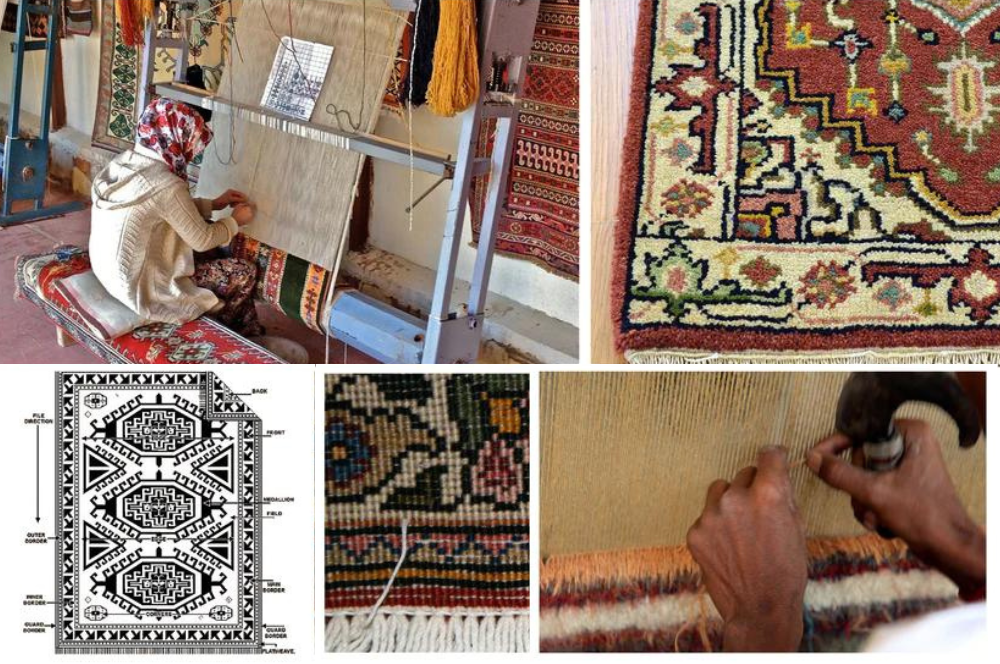
The knotting phase is where the magic happens. Artisans tie individual knots around pairs of warp threads, row by row. Each strand of yarn is strategically positioned and wrapped to form the knot, making it critical for achieving a beautiful, dense structure. Depending on the size and intricacy of the rug, this stage can take 8 to 24 weeks or longer. Understand more about the knotting process here.
5. Trimming and Finishing
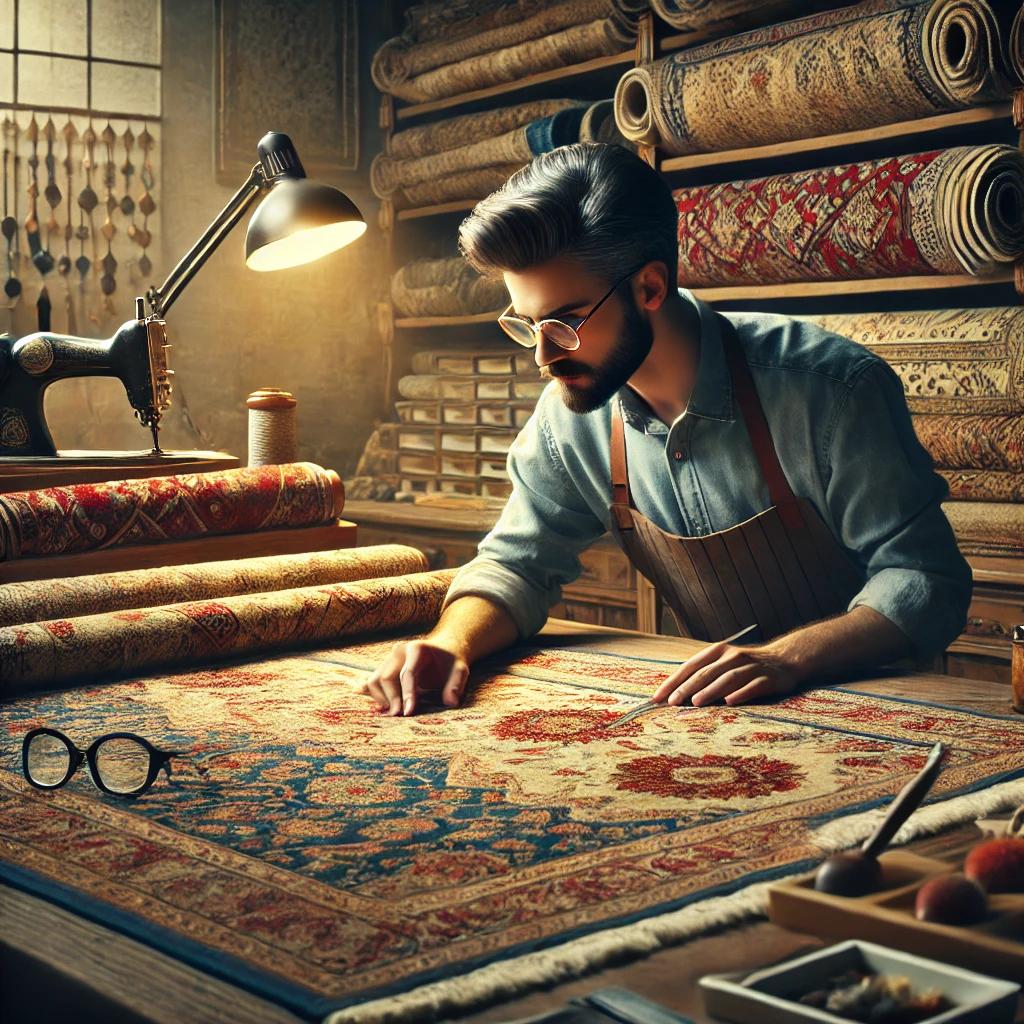
Once knotting is complete, artisans carefully trim the pile to create a uniform surface. This step sharpens the clarity of the design and ensures a pleasing texture. Precision in trimming is essential, as uneven trimming can obscure motifs. Discover more about trimming and finishing here.
6. Washing, Stretching, and Drying
After trimming, rugs are washed multiple times to remove any lingering dye and soften fibers, enhancing the handle and appearance. Following this, they are stretched and dried, often in the shade, to maintain their shape. This stage is crucial for the rug’s final texture and structure. Learn more about the washing process here.
7. Final Inspection and Quality Control
Finally, the completed rug undergoes a thorough quality inspection. This ensures that the knots are consistent, patterns are accurate, and the colors hold fast. Any small defects are corrected, and the rug is then made ready for sale, marking the culmination of the artisan’s hard work and dedication. Explore final inspection methods here.
Materials, Tools, and Techniques
Core Materials
The choice of core materials is essential in rug making:
- Pile yarns: Wool is favored for its durability, while silk is prized for its luster and fine detail.
- Warp threads: Generally made from cotton or wool, these threads form the vertical skeleton that supports the knots.
- Weft threads: These horizontal yarns play a supportive role, stabilizing the structure by locking rows of knots.
Typical Tools
Essential tools for rug making include:
- Looms (either vertical or horizontal)
- Scissors or shears for cutting and shaping the pile
- Beating combs for compacting weft and knot rows
- Design charts for layout guidance
Artistry and Precision
The artistry and precision required in each step are paramount:
- It is critical to maintain accurate knot placement for pattern fidelity.
- Even tension across warps and wefts is necessary to ensure the rug retains its flat shape.
- Controlled trimming is needed to reveal detailed patterns without compromising the pile.
Creating high-quality hand knotted rugs requires not only skill but a keen eye for detail, making them artistic and functional resources. For tips on evaluating quality, check out Spotting Quality: Tips for Evaluating Handmade Rugs. Read more about the artistry of rug making here.
Persian Rugs Techniques
Key Knot Types: Senneh and Ghiordes
Persian rug craftsmanship relies heavily on specific knot types:
- Senneh knot (asymmetrical): This knot allows finer weaving and is often used for intricate floral and arabesque designs.
- Ghiordes knot (symmetrical): Known for its robust and balanced structure, this knot embellishes geometric patterns.
Both types fundamentally impact the visual complexity of Persian rugs, with the Senneh knot typically associated with city rugs and the Ghiordes knot often found in more simplistic designs. Learn more about these knots here.
Design Patterns and Color Play
Persian rugs are known for their visually striking design patterns, including:
- Medallions and floral fields
- Geometric layouts
- Hunting scenes with intricate borders
Color harmonization plays a key role, utilizing rich palettes that integrate reds, blues, and creams, achieved through expert dyeing techniques. The weaving style focuses on high knot density to create detailed imagery, which requires steady skill and artistry. Explore Persian rug designs further here.
Comparison with Other Cultures
Persian rug techniques are just one branch of a larger family of weaving traditions. For example:
- Anatolian or Turkish rugs favor the Ghiordes knot, emphasizing bold contrasts and geometric patterns.
- Central Asian tribal rugs often use more spontaneous and simplified designs, reflecting nomadic lifestyles.
- Indian rugs typically draw inspiration from Persian designs, adapting motifs and materials based on local preferences.
These distinctions highlight how Persian rug techniques form a vital component in the broader tree of global rug-making traditions. Learn about cultural comparisons here.
Craftsmanship Processes and Best Practices
Techniques Passed Down Through Generations
Techniques for hand knotted rug making have evolved over centuries but remain fundamentally traditional. Artisans often pass skills through families or workshops, with experienced craftsmen mentoring younger generations on essential practices, speed, and the nuances of pattern reading. Explore craftsmanship training here.
Common Challenges and Quality Tips
Challenges in rug making can include:
- Maintaining even tension: Unequal tension across warp or weft leads to shapes and distortions.
- Pattern alignment: Errors in counting knots or color choices can misalign designs. Careful counting and a clear design chart help mitigate these issues.
- Color consistency: Variations in dye batches can impact color uniformity.
To achieve high quality, consider:
- Using premium, well-processed fibers that stabilize the pile.
- Regularly monitoring tension and loom alignment during weaving.
- Carrying out thorough final inspections prior to shipping. Find tips for quality here.
Mastery and Preservation of the Art Form
Mastering these techniques not only elevates the quality of the finished product, resulting in sharper patterns and better color depth, but also helps preserve this ancient art form. Understanding the core methods enables artisans to maintain and adapt their heritage effectively. Learn how to preserve this craft here.
Conclusion: Bringing History and Technique Together
The history of rug making—rooted in ancient knotted carpets like the Pazyryk through to the sophisticated Persian designs—weaves a rich narrative that is integral to understanding modern hand knotted rugs. The journey of “hand knotted rugs how to make” encapsulates not just the manual handiwork involved but also the artistic expression imbued within each creation.
By diving into these detailed processes—designing, preparing, warping, knotting, washing, and finishing—we appreciate not only the beauty of the rugs but also the dedication required to produce them. The techniques imparted by Persian artisans, especially through methods involving Senneh and Ghiordes knots, have set benchmarks for craftsmanship worldwide. Readers are encouraged to explore these enchanting artifacts, whether by appreciating existing pieces or attempting to engage in small-scale rug-making themselves. The legacy of hand knotted rugs is waiting to be both admired and carried on, reflecting centuries of skill, tradition, and artistry. Find out more about the craft of rug making here.